
The 4th and 5th Proposal Writing Workshop
Date and time: The 4th WS: July 31th (Wed), 2024, 13:00-14:30
The 5th WS: August 6th(Tue), 2024, 13:00-14:30
Participants: The 4th WS: 4 persons (Modon from DASCOH, Bangladesh
Inday from ANAK-NC, Philippines、Laksiri from NAFSO, Sri Lanka、Sujata from CSNR, India)
The 5th WS: 2 person (Adel from YVO, Afghanistan, Thadsa from NAFSO,Sri Lanka)
Today’s goal:
To learn how to conduct “Problem Analysis” and “Objective Analysis”
Key Points Discussed:
First, the participants reviewed the lessons learned from the previous sessions. After that, Yayoi from AHI explained how to conduct a “Problem Analysis” followed by an “Objective Analysis”.
- Problem Analysis ===========================================================
Purpose: To visually lay out the problems in a cause-and-effect tree, showing the relationships between them.
How to Do:
- List major problems that the tentative target group face
- Agree upon a core problem among them

- Analyze the causes of the core problem (But why? Analysis)
- Analyze the effects of the core problem
- Form a diagram showing the cause-and-effect relationships
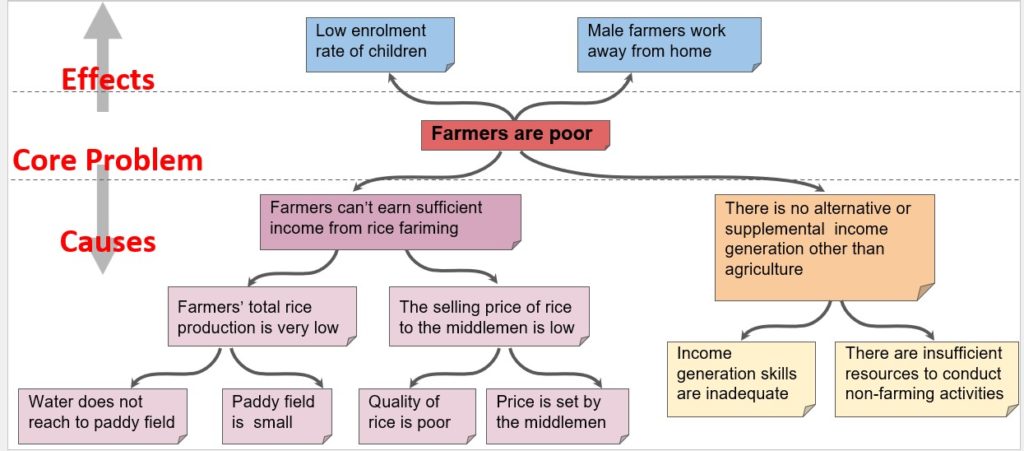
Yayoi mentioned that the selection of the core problem should consider the capacity of the implementing agencies, the availability of supporting groups, and the funding agencies. In the sample case, if the implementing agencies and supporting groups are an expert in agricultural areas and lacks the capacity to promote alternative income generation outside of agriculture, the core problem should be focused on agriculture as follows. Yayoi said that it is acceptable to start the analysis with a tentative core problem. During the analysis process, the ideal core problem will naturally be revealed.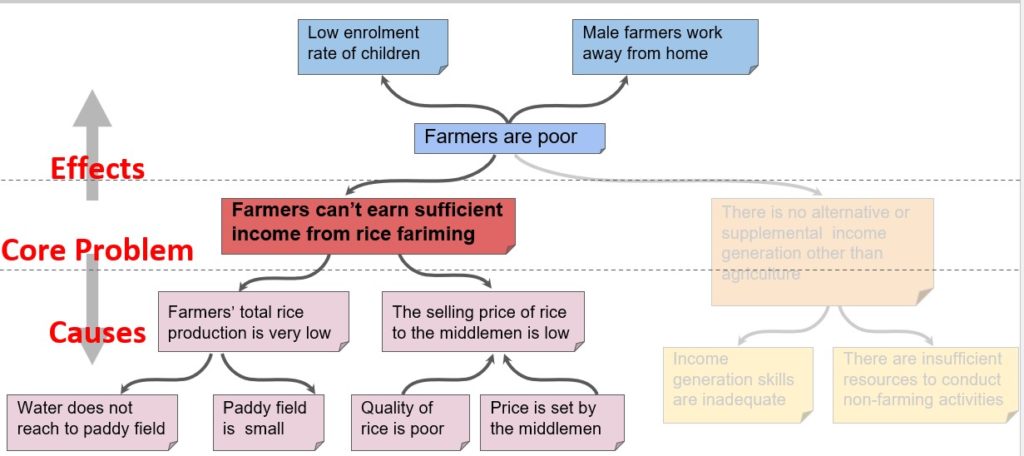
Modon asked how deep we should continue the “But why?” analysis.
Yayoi answered, “It is better to analyze as deeply as possible, slightly beyond the community level. However, this analysis should be conducted in a participatory manner, which is a time-consuming process since all participants need to agree on the entire analysis results. Therefore, in reality, we must balance deep analysis with the time available.
2.Objective Analysis ==========================================================
Purpose: To develop a common vision of the situation that would be achieved by solving the problems.
How to Do:
- Restate all negative statements of the Problem Analysis diagram into positive statements that are desirable and realistically achievable.
- Examine the means and ends relationship thus derived to assure validity and completeness of the diagram.
- If necessary, revise statements and delete unnecessary statements.
Restate all negative statements of the Problem Analysis diagram into positive statements that are desirable and realistically achievable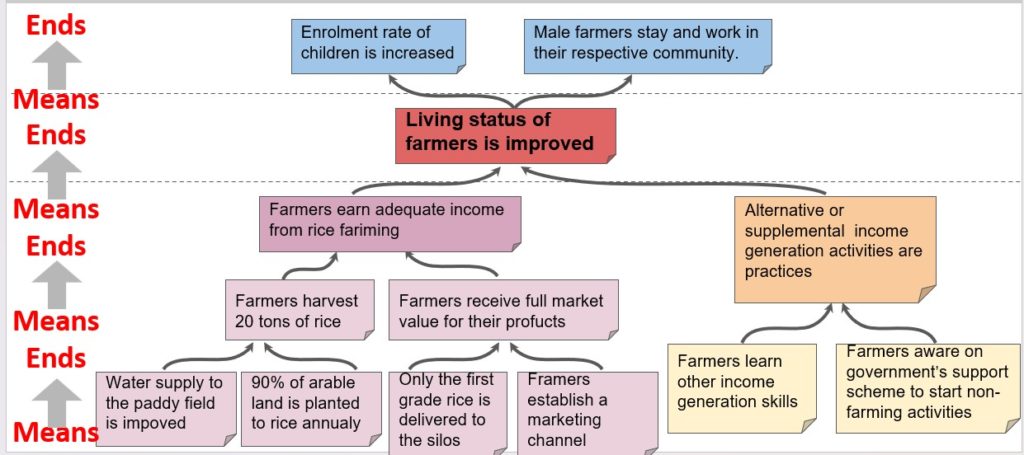
Yayoi mentioned that the flow of the analysis stages is fixed: 1. Stakeholder Analysis, 2. Problem Analysis, 3. Objective Analysis, and 4. Alternative Analysis. This sequence is necessary because each analysis builds on the results of the previous one. Specifically, the Stakeholder Analysis identifies the target group and their problems, which then informs the Problem Analysis. Subsequently, the Objective Analysis is conducted based on the Problem Analysis diagram.
Yayoi recommended trying out the following: 1. Stakeholder Analysis, 2. Problem Analysis, and 3. Objective Analysis. This exercise will help the participants understand the rationale behind the sequence. The participants agreed to complete this assignment by the next workshop, scheduled for October 9th (Wed).


One thought on “The 4th and 5th Proposal Writing Workshop”
Comments are closed.