
the 2nd session of Health Assembly for social participation in Health Policy
Date: May 10th, 2024
Number of participants: 10
India: Stalin (ILDC 2019), Ambrose, Jalaluddeen, Chhaya (ILDC 2019), <Swapnil, Sheela, Sujata (Health Equity Course-2023)>
Thailand: Khanitta (ILDC 2019), Nanoot
Sri Lanka: Thadsa (ILDC2023)
Brief report of the 2nd session
Khanitta and Nanoot shared on the HAs in Thailand.
Outline:
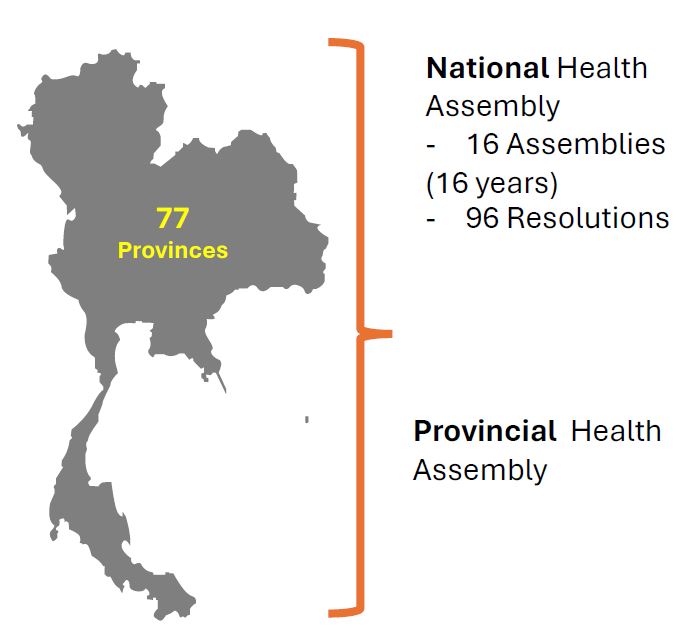
-A process and platform for developing participatory public policies based on collective wisdom. 77 provinces have provincial networks.
-Bbring together 3 sectors – government, academia, and the people’s sector – from both health and non-health backgrounds to dialogue for healthy public policies and solutions.
–3 types of HAs: 1) National HA (This year- the 17th), 2) Provincial HA, and 3) Issue-Based HA.
Key Mechanism:
- Organizing Committee: The National Health Commission, supervised by the Prime Minister of Thailand, is responsible for organizing the three types of HAs as part of the participatory health governance mechanism.
- NHA Organizing Committee: This committee consists of representatives from the government, academia, and the people’s sector. Government representatives include those from the Ministry of Interior, Ministry of Public Health, Ministry of Education, and local government bodies. The people’s sector is represented by groups such as sea gypsy communities, organic farming groups, water resource management groups, and young generations.
- National Resolution Follow-up Committee: Another committee consisting of representatives from the three sectors. This committee works for many years, supporting key stakeholders until the resolution is fully and successfully implemented.
(Document by Khanitta)
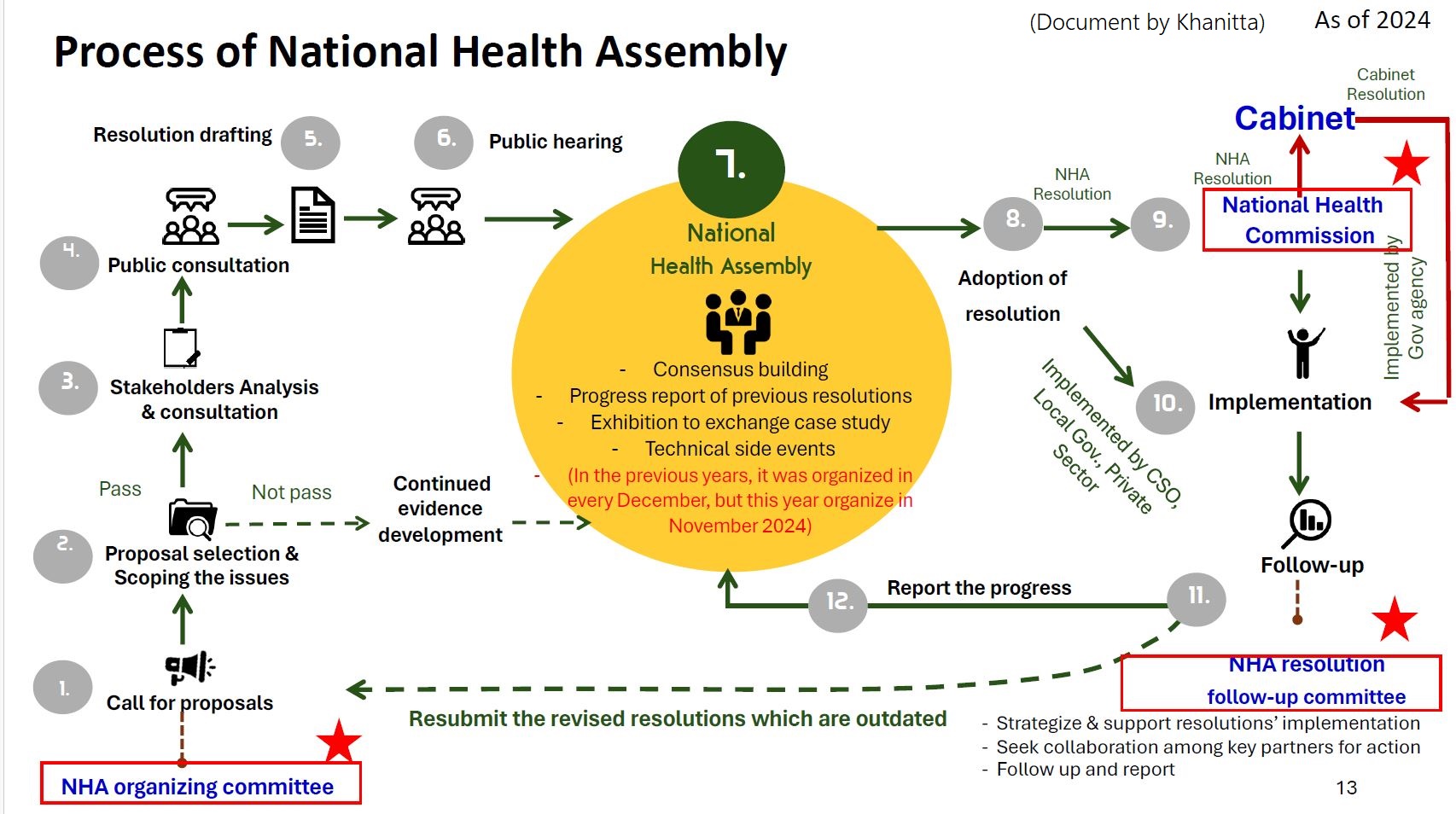
- Call for Proposals: Invite people from Thai society to submit proposals about specific problems.
- Proposal Selection & Scoping: Classify proposals and scope issues.
- Stakeholder Analysis and Consultation: Conduct analysis and consultations with stakeholders.
- Public Consultation: Invite key actors to discuss possible and acceptable solutions for society, identifying the direction of resolutions.
- Draft Resolution: Draft the resolution based on consultations.
- Public Hearing: Conduct hearings in selected provinces to explore the feasibility and gather feedback on the drafted resolution.
- National HA: Conduct the National HA for 1-2 days (usually in December, but in November this year) to adopt the resolution, present progress reports of the resolutions adopted in the former National HAs, and exhibit case studies.(1-7 takes one year.
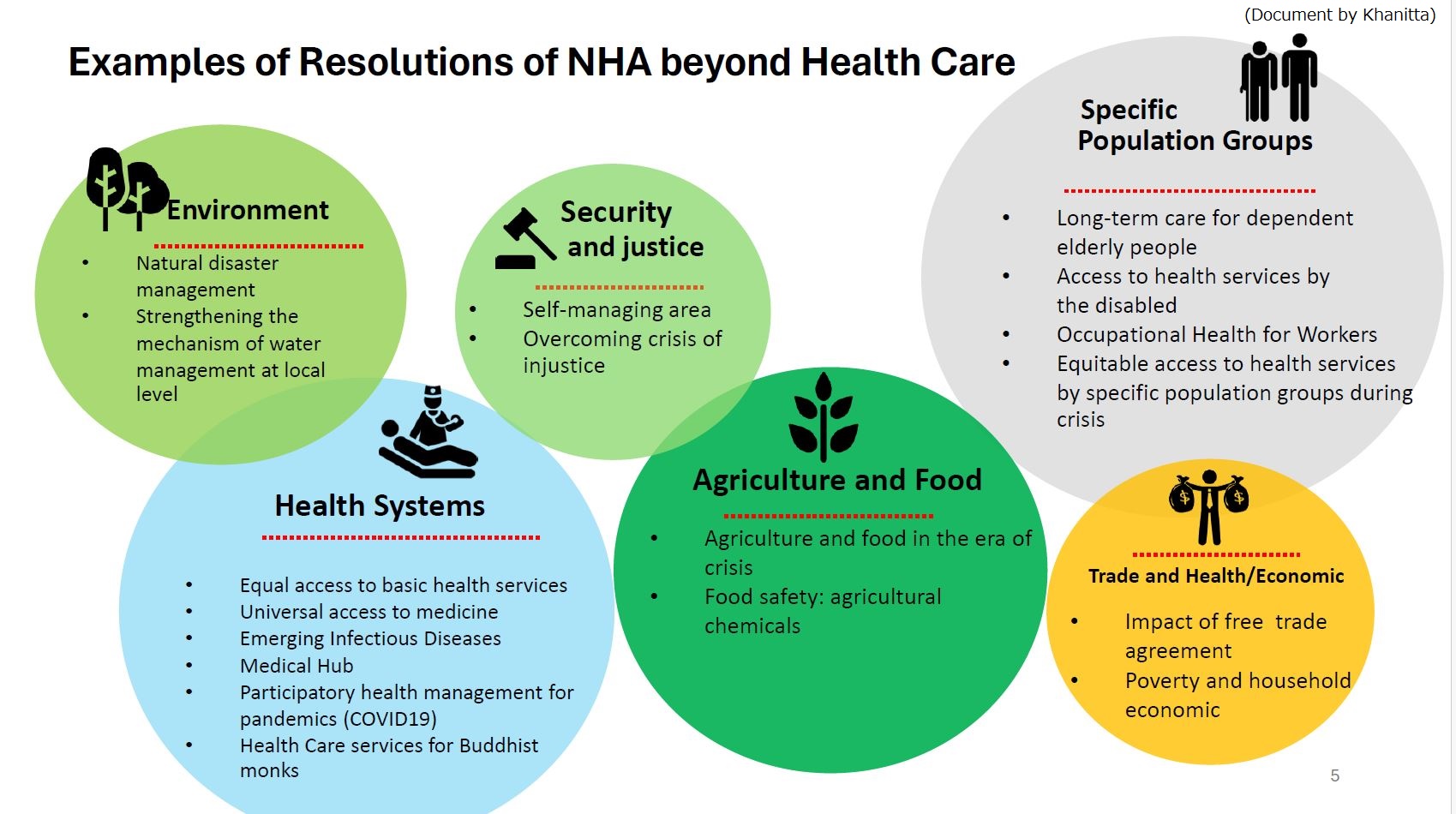
- & 9. The adoption of resolution: Sent to the National Health Commission, then proposed to the Cabinet. The resolutions adopted in the National HA are not only about healthcare (e.g., healthcare services for Buddhist monks) but also cover social and environmental issues (e.g., strengthening local mechanisms for water resource management, food safety).
10&11 Implementation of Resolution: This process takes many years. (Ex. the resolution on reducing dangerous chemicals in agriculture has been ongoing for 10 years.)
The NHCO creates the platform for the National HA and facilitates the process but does not implement the resolutions. Participants of the National HA are responsible for implementation. For instance, if a resolution on equal access to healthcare services is adopted, the Ministry of Public Health (MoPH) is the responsible organization.
Q&A:
Q: What is the difference between the public hearing (#6) and the National HA (#7), and their levels of conduction?
A: Public hearings are held at both national and provincial levels, with participation from all 77 provinces. NHCO identifies appropriate provinces for provincial-level public hearings. Draft resolutions are uploaded online, and feedback is gathered through meetings, online platform, and public opinions from national and provincial government offices.
Q: What is the difference between National and Provincial HAs?
A: The National HA model is systematic and complex, and Provincial HAs are more flexible. While Provincial HAs address local issues solvable by local government and communities ex) the development of local rice, the National HAs deal with national agendas requiring involvement from multiple ministries. The agenda at the National HA should be adopted, and the resolutions should be implemented at the provincial level, adjusted to their local context.
Q: How many resolutions are drafted each year?
A: National HA has adopted 10 resolutions per year, which reduced to 3 for ensuring quality and effective monitoring.
Q: (Comparing with situation in India), Do HAs in Thailand have the power to impose penalties against the private health sector?
A: HAs can only discuss and adopt resolutions. The government decides on regulations and penalties. The National Health Commission Office is under the Prime Minister’s Office, allowing coordination with various ministries and addressing a broader range of issues.
Based on the questions raised by India team over the District HAs of Tamil Nadu not very focusing on community-level health gaps, multi-sectoral discussion and solutions, participants agreed to learn on Thailand’s experience in changing the mindset of the government and healthcare providers to make HAs a platform for equitable discussion with the people’s sector.
- Categories
- Uncategorized

One thought on “the 2nd session of Health Assembly for social participation in Health Policy”
Comments are closed.