12/12/2025/ Last updated : 13/01/2026admin_ahiAlumni now
Voice from coordinator of ILDC2025(AHI alumnus)
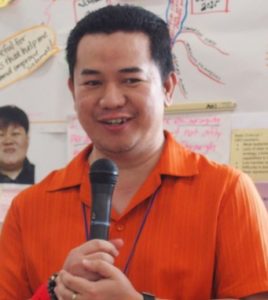
John A-aron Manangkil Lumbab, Training and Consultancy Coordinator,DMSF-IPHC
Aaron participated in ILDC in 2016. This time, he joined ILDC 2025 as one of the coordinators. He started by finalizing the application forms, then took part in selecting participants, and finally contributed to the actual management of the training program.
We asked his experiences and learning as an international training coordinator, as well as his perspectives for the future.
How did it feel to return to AHI after nine years?
I never imagined coming back after such a long time. When I stepped onto the grounds, so many memories came flooding back. It was nostalgic—but this time, I was seeing everything from different perspectives, as a coordinator.
Focusing on other participants’ learning needs
As a training participant, I mainly focused on my own growth and learning needs, while taking on various roles as required. As a coordinator, however, I began to pay more attention—though not entirely, to most participants’ needs. By doing so, I tried to provide appropriate support and help each participant realize their full potential for learning.
To be honest, at first I was testing the waters.
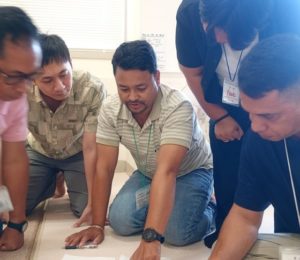
It was difficult to know how much I should step in during the sessions. In the beginning, participants tended to rely on the coordinators. For example, during small group discussions, some participants would ask me, “Aaron, do you think it is OK?” But that was not my role. I was not there to judge whether something was right or wrong. It was for them to think about what they believed was good and what approaches could help deepen the discussion. Our role as coordinators is not to “guide” but to “support.” So in such situations, I did not answer their questions directly. Instead, I encouraged the participants to think for themselves as much as possible, and only when I felt that the conversation was going in circles did I offer a small piece of advice or a hint. I constantly reminded myself not to lose sight of my role. Gradually, the participants also came to understand this role, and week by week, they began to take more initiative in their discussions. I, in turn, became more of a shadow.
What was a memorable experience for you as a coordinator?
There was a situation where one participant was not actively involved in the preparation group for the next day’s session. Since I was younger than him, I approached him gently and spoke with him one-on-one. First, I checked whether he understood the topic of the day—advocacy—and then confirmed whether he understood the role of the preparation group. By going through each point step by step, he seemed to arrive at the answer on his own. After that, although not perfectly, he made a genuine effort to fulfill his commitment. In his mid-term reflection, he even wrote that if he is ever part of the learning team again, he will devote himself fully. I can say that his attitude changed 180 degrees. It was a very humbling experience for me.
What did you learn from taking on this new role as a coordinator?
This entire experience contributed greatly to my growth, both personally and professionally. Serving as a coordinator for ILDC 2025 was a valuable opportunity to revisit and re-learn the processes of participatory development, and it reminded me of our core purpose—to support the improvement of the lives of people in socially vulnerable situations.
By listening to participants from different countries, I realized, “It is not only us; similar inequalities exist all over the world.” This is not just a local issue, but a global challenge. Knowing that many others are also confronting these inequalities in their own contexts encouraged me deeply.
What makes the AHI training unique?
AHI training is truly unique, with participants themselves serving as resource persons and a live-in style in an intercultural setting that brings together a diverse group of individuals. This kind of setting is uncommon in most trainings I have experienced. Having participants from diverse backgrounds presents both opportunities and challenges. It is an opportunity to learn about different cultures and to understand the challenges faced by marginalized communities in various contexts. At the same time, it can be challenging, as individuals may hold different beliefs and perspectives that do not always align. This is why compromise and mutual understanding are essential for creating a harmonious and productive environment.
At the end of the course, most participants expressed their intention to first focus on applying what they had learned to capacity development activities for CBO members. I am excited to support a continuous learning journey among ILDC2025 alumni and other members.
Message for future participants and future coordinators.
To the future participants: Congratulations and make the most of this learning experience. I won’t spoil so much, just expect the unexpected! To the future coordinator: Trust in yourself, you were selected because something is unique within you. Your hands-on field experience combined with your ILDC training experience will serve as your strongest asset in fulfilling the role. Be authentic and don’t hesitate to ask questions. Always remember that AHI and us former coordinators will always be there to guide and support you. We are rooting for you!
Learning together, walking together.
His words remind us that AHI’s training is not just a program, but a living community where people from different backgrounds learn, share, and grow together. Those who continue learning become the ones who support others in their learning afterward. This circle of connection will keep expanding into the future.
.jpg)
-1024x628.jpg)